
A garden feeder is one of the best classrooms in Britain. Hang up a bag of sunflower hearts and within days you'll have a rotating cast of visitors, most of them within a few metres of your window. The mistake is trying to learn every bird in the book at once. Learn five properly and the rest start to fall into place.
Below are fifteen species you can reasonably expect to see, with what they look like, what they sound like and how they behave. Size, shape and behaviour will get you further than plumage in the first few weeks, because a wet blue tit in February rarely matches the picture in a field guide.
Before you look at colour, look at shape
Colour fades in dull light and disappears entirely in silhouette, so start with the basics.
- Size. Compare every bird to a house sparrow or a blackbird. Smaller than a sparrow, or bigger than a blackbird?
- Bill. Fine and pointed suggests insects and small seeds. Short and stubby means a seed-cracker. Long and thin means a prober.
- Tail. Long, short, forked, cocked up or constantly wagged.
- Behaviour. Hangs upside down, feeds on the ground, arrives in a flock, or chases everything else off.
- Movement. Most garden birds hop. Starlings and pigeons walk.
Run through that list before you reach for a guide and you will usually be down to two or three candidates. Only then is it worth asking about the colour of the legs or the exact shade of brown.
The birds you'll meet in the first week
The small ones
Robin. Round, upright and permanently anxious-looking. Rusty orange breast, brown back, beady black eye, thin dark legs. Robins sing almost all year, and theirs is usually the first song you learn — a thin, wistful warble that seems to speed up and slow down at random. They are fiercely territorial and will see off a rival twice their size. At the feeder they prefer the ground or a low perch beneath it, and in the garden they will follow a spade around the border waiting for worms. Males and females look identical, which catches people out; young birds in summer are speckled brown with no red at all.
Blue Tit. The bird most people learn first, and deservedly so. Small, bright, with a blue cap and wings, yellow underparts, and a white face crossed by a dark line through the eye. It hangs upside down from peanuts, dangles off fat balls, and squabbles constantly while losing every argument to anything with a bigger bill. The call is a thin, hurried see-see-see, and the spring song is a repeated tsee-tsee-tsee-tsee that sounds faintly like a bicycle being pumped up.
Great Tit. Bigger, bolder and louder than a blue tit, with a black head, white cheeks and yellow underparts split by a black stripe — wider on males. Its two-note song is the one everybody notices in February: a ringing, metallic teacher-teacher, or sometimes a see-saw. It is usually the first bird on the feeder in the morning and the first to complain when the food runs out.
Coal Tit. The one people miss. Like a small, sober great tit, but with a white patch on the nape that neither the great nor the blue tit has, and no yellow anywhere. It tends to dart in, take one seed and leave, rather than settling to feed, and it caches food obsessively in cracks and crevices.
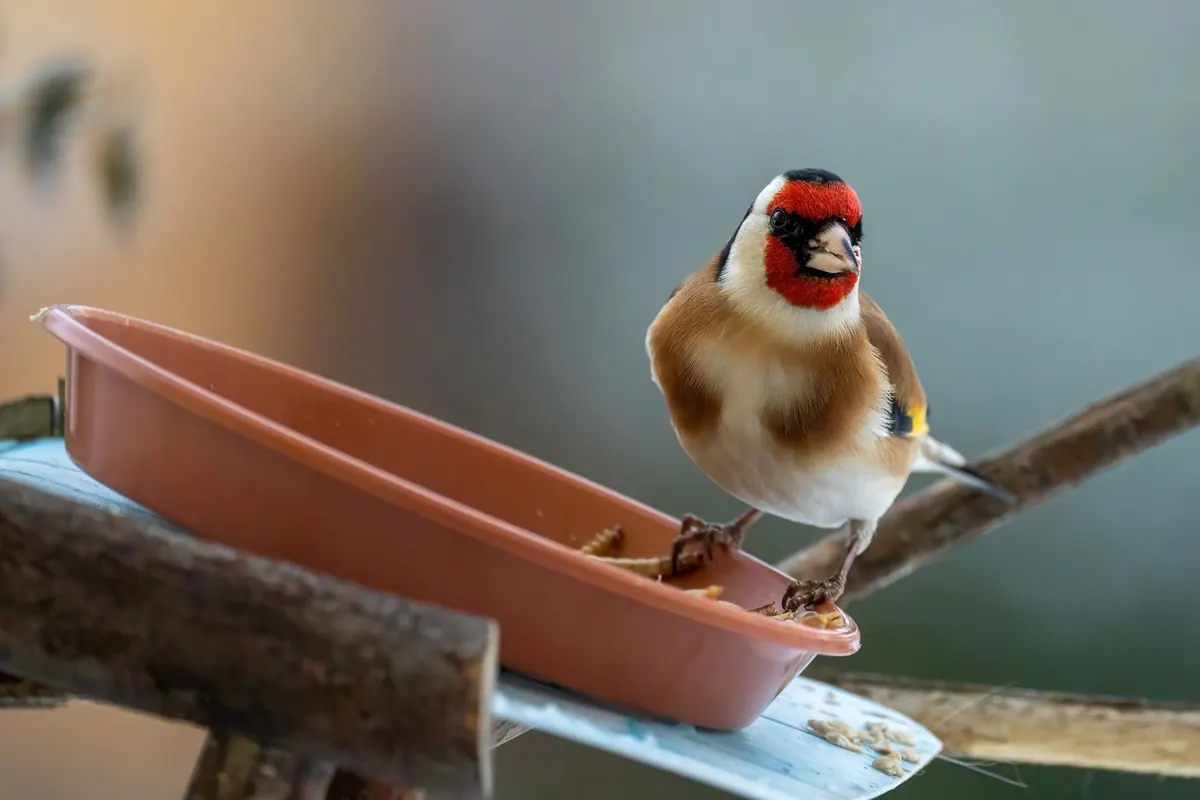
Goldfinch. Red face, black and white head, a broad gold bar on the wing and a long, fine bill built for nyjer and teasel. Goldfinches usually arrive as a chattering flock, all tinkling liquid calls, and then depart together for no obvious reason. Their numbers in British gardens have risen sharply since feeders started offering fine seed.
Chaffinch. One of our commonest birds, though not always a feeder user. The male is a cheerful pinkish-brown with a blue-grey cap and a bold double white bar on the wing; the female is plain brown and is regularly mistaken for a sparrow. Chaffinches spend a lot of time on the ground beneath the feeder, hoovering up spill. The song is a confident descending run that ends in a flourish.
Greenfinch. Chunky and olive-green with a heavy pale bill and a flash of yellow along the wing edge. The call is a wheezy dzee, and the song has a nasal, almost complaining twang. Numbers fell sharply after an outbreak of trichomonosis, so it is a bird worth reporting — and worth keeping your feeders clean for.
House Sparrow. The benchmark against which everything else is measured. Brown and grey, stubby, sociable, noisy and almost always in a group. Males have a grey crown and a black bib; females are plain sandy brown with a pale stripe behind the eye. They dust-bathe in dry soil, bicker in hedges, and rarely travel more than a few hundred metres from where they hatched.
Dunnock. A quiet brown bird with a grey face and breast, a fine pointed bill and dark streaks on the back — easily dismissed as "just a sparrow". Watch it for a moment, though, and you will see the difference: it shuffles along the ground with a nervous, twitchy motion, flicking its wings, usually alone or in twos. The song is a bright, hurried little warble delivered from the top of a low bush.
The medium and larger birds
Blackbird. Bigger than a sparrow, smaller than a pigeon, with a long tail and a distinctive run-and-pause across the lawn, head cocked to listen for worms. Males are black with a bright orange-yellow bill and eye-ring; females are brown with a paler, faintly streaked throat. The song is rich, fluting and unhurried — heard from a rooftop at dusk between March and July.
Starling. Glossy black, heavily speckled with pale spots in winter and showing green and purple iridescence in summer, with a yellow bill. It walks rather than hops, and it is noisy, gregarious and a superb mimic — a single bird can run through a curlew, a telephone and a car alarm in one phrase.
Wood Pigeon. The large grey bird with a white neck patch, pinkish breast and a talent for exploding out of a bush with a clatter of wings. It walks about under the feeder clearing up everything that falls. The song is a lazy five-note coo-coo, coo, coo-coo, repeated all day.
Collared Dove. Slightly smaller and paler than a wood pigeon, sandy-grey with a black half-collar on the neck and a red eye. Its three-note call, coo-COO-coo, is often mistaken for a cuckoo. Collared doves only arrived in Britain in the 1950s and are now in almost every garden.
Magpie. Unmistakable black-and-white crow with a long tail and a loud, chattering rattle. Bold, clever and opportunistic — it will take scraps, eggs and nestlings. Some gardeners resent them, though they are no more to blame for songbird declines than cats or habitat loss.
Jackdaw. The small crow: black, with a grey nape and a pale eye, usually in pairs or rowdy flocks. A rooftop and chimney nester, full of cheek, and quicker than anything else at emptying a fat-ball feeder.
Common confusions to watch out for
Most identification mistakes in a British garden come from a handful of pairs. Learn these and your accuracy jumps immediately.
- Dunnock or house sparrow? Dunnocks are grey-faced, fine-billed, solitary and shuffle. Sparrows are brown, stubby-billed, noisy and in a gang.
- Female chaffinch or sparrow? Look at the wings — a chaffinch has two clear white bars.
- Coal tit or great tit? Check the back of the neck for a white patch, and the belly for yellow.
- Starling or blackbird? Starlings walk, are speckled, and have short tails and pointed wings. Blackbirds hop and have long tails.
- Collared dove or wood pigeon? Size, the black neck collar and the call.
- Jackdaw or crow? Jackdaws are noticeably smaller, with a grey nape and a pale eye; carrion crows are uniformly black and usually alone.
Making the watching easier
A few simple choices turn a casual glance out of the window into a genuine daily count.
- Offer a range of food. Sunflower hearts suit almost everything, nyjer brings goldfinches, and suet balls keep blue tits and great tits coming through winter. A tray of spill on the ground will pull in dunnocks, chaffinches and pigeons.
- Clean feeders regularly. Warm soapy water every couple of weeks, and rotate feeding points so droppings don't build up underneath. This matters more than any other single thing you can do.
- Provide water. A shallow dish, refreshed daily, is used by birds that never touch your feeders.
- Leave some mess. A patch of long grass, a log pile and a berry-bearing shrub such as hawthorn or rowan will bring in species that never visit a feeder.
- Keep notes. A notebook by the window with the date, the weather and the first bird you see each morning will teach you more in a year than any app.
You do not need to identify everything. You need to recognise five birds instantly, and then notice when something is not one of them.
That is the whole trick. Five birds, learned well, become a framework — and every unfamiliar visitor that arrives will be measured against them. Within a season you will have fifteen, and within a year or two you'll know your garden's regulars by their calls before you even look up from the kettle.
Photo: Gundula Vogel / Pexels
Related posts
More stories you’ll love reading